
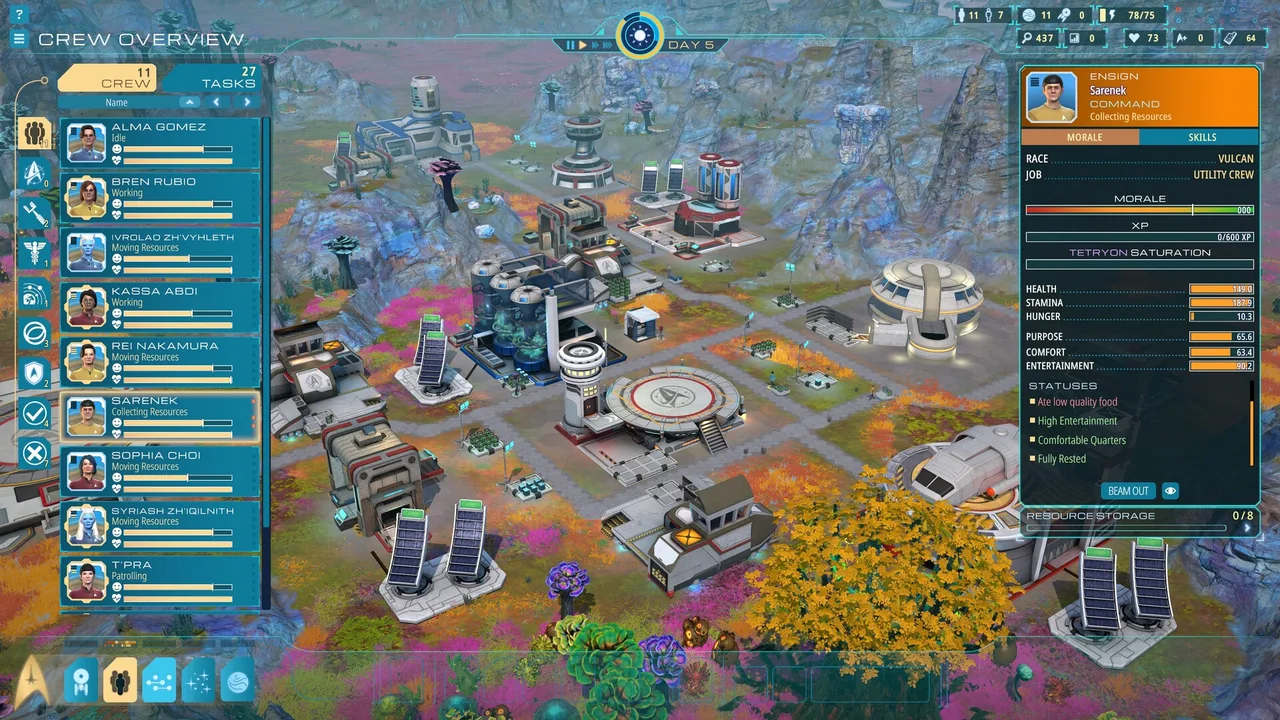
Official Steam screenshot · Magic Fuel Games / Playstack · TM & © 2026 CBS Studios Inc. Material statement.
Check the assignment before expanding production
The firsthand preview repeatedly connects outpost work with the need to reassign staff. That gives you a useful first question when an activity is not progressing: is the intended work actually assigned? Building another facility does not answer that question by itself because construction and production belong to the same staffing context.
This is a diagnostic principle rather than a prescribed crew ratio. The collected material does not measure one universal allocation as the most efficient arrangement. Use the crew information and the task that is actually waiting to decide what needs attention, rather than treating another player's early assignment choices as an optimal template.
Follow the missing input, not just the visible building
The official resource description connects outpost operations with several stages and dependencies. A problem can concern the supply that supports an activity rather than the structure in which that activity occurs. Before increasing production capacity, establish which part of the documented chain is meant to supply the work.
This helps separate a shortage from a different type of blockage. More extraction cannot automatically resolve a missing connection or an unavailable prerequisite. The resource guide explains the documented stages in more detail, while this checklist keeps the immediate question focused on identifying the dependency instead of blindly expanding everything.
Check utilities when something is not functioning
The developer describes utility requirements as part of outpost design, and the two demo recordings contain independent power-related problems. Retro-Badger's transcript flags insufficient power around 39:25, while RonEmpire discusses a connection issue in a later part of the session. These passages support checking utilities without establishing that every failure has the same cause.
Treat a utility check as a category of investigation, not a guaranteed repair procedure. A building may have an input, distribution, or other dependency that needs to be understood in the actual version you are playing. No exact power ratio or universal infrastructure formula was established by the material used for these tips.
Leave room for the infrastructure your plan needs
The official logistics material says that utility networks take up space. That makes infrastructure access part of a construction plan rather than a detail to ignore until every structure has been placed. The practical implication is to consider how the facilities will be supported while deciding where they belong.
The research does not establish a mandatory corridor width or a single ideal base footprint. Those would be numerical layout claims requiring evidence that has not been collected. Use the layout page for the documented constraints, and keep the difference between reserving useful access and copying an untested universal blueprint clear.
Read upgrade and research prerequisites separately
The collected material identifies progression alongside construction and research. If an intended structure is unavailable, check whether the issue is an unlock rather than assuming that additional resources alone will solve it. The building and research pages distinguish those dependencies using the limited demo evidence available.
This check avoids treating every blocked task as the same kind of problem. An assignment, a supplied input, a connection, and a prerequisite can each point to a different next step. The sources support recognizing those categories, but they do not justify an invented final technology order or a guaranteed shortcut through it.
Recheck advice taken from early demonstrations
The developer made late changes to infrastructure balance after the earliest demo recordings. RonEmpire's transcript around 01:19:36–01:20:27 is useful as a placement lesson, but its old cost context should not be reproduced as a current price table. A later official announcement is more relevant when the question concerns an explicitly changed system.
This is particularly important for tips framed around what construction costs or how long an action takes. An observation can be accurate about the recorded build and still need revision after an update. Keep the version context beside the advice instead of converting an old demonstration into an unqualified rule for the release.
Connect crew needs with the wider plan
The later hands-on preview connects crew needs with settlement infrastructure rather than isolating them from the rest of the outpost. That supports checking whether an expansion plan also accounts for the people who must carry out its work. The number of structures alone is not a complete explanation of whether the documented management loop can support the intended activity.
Use this as a planning question, not a numerical efficiency promise. The research does not provide a measured best schedule, a proven staffing formula, or an arrangement that eliminates every risk. The useful tip is to connect your next building decision with the assignments and support dependencies already identified in the sources.
Which kind of tip is worth carrying between builds?
A broad diagnostic question can remain useful without promising a particular numerical result. Asking whether work has an assignment or whether a facility has its documented support is different from prescribing a fixed production ratio. The first follows the systems described in the sources, while the second would require measurements the research does not supply.
Version-specific tips need a narrower reading. A cost observed in early footage may no longer describe a system after an official adjustment. Preserve the date and use the recorded example to understand the issue, rather than copying its old value into a supposedly permanent shortcut.
This distinction helps keep practical advice honest and easy to use. Start with the observable blocker, choose the relevant documented relationship, and examine the result in your actual build. That is more dependable than advertising a collection of exploits, guaranteed efficiencies, or invisible bonuses that were never verified in the collected material.
Solve one identified constraint at a time
A clear diagnosis is more useful than a long list of speculative tricks. First identify the work that is waiting, then establish which documented dependency is missing, and finally check the corresponding system page. This keeps the decision tied to observed information rather than a guessed exploit or another player's unverified optimal route.
The sources support these checks as editorial planning guidance, not as the developer's prescribed fastest strategy. Any numerical shortcut or version-specific trick needs its own verification before being presented as proven. Until then, the dependable approach is to understand the blocker, apply the relevant documented relationship, and recheck whether the intended work can proceed.
Sources and update context
This page uses the official information collected for the October 18, 2026 research pass. Pre-release descriptions may change. Refer to the current storefront and developer announcements for availability and launch details.
- Captain’s Devlog #3 — Resources, Logistics, and Star Trek 60th
- Captain’s Devlog #4 — 5 Days Until Launch!
- GameGrin — Star Trek: Outposts Unknown Preview
- But Why Tho? — Star Trek: Outposts Unknown Is A Star Trek Colony-Sim In Every Way
- RonEmpire — Full Gameplay, Steam Next Fest demo
- Retro-Badger-Gaming — Demo Playthrough with Commentary