
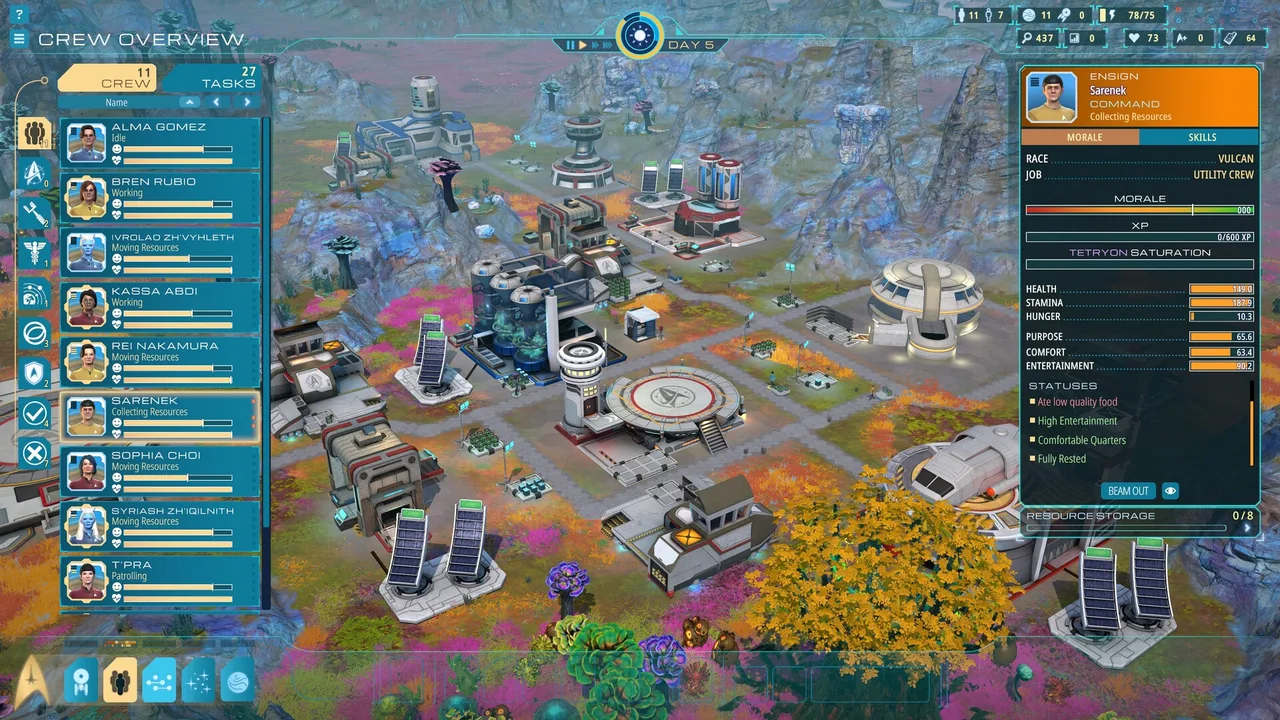
Official Steam screenshot · Magic Fuel Games / Playstack · TM & © 2026 CBS Studios Inc. Material statement.
Separate the reasons a building may be unavailable
Material availability, construction staffing, and blueprint access are different questions. The researched preview describes crew being reassigned between producing supplies and carrying out construction. That means selecting a structure does not, by itself, establish that the people and inputs needed for the work are ready.
A useful first step is to identify which dependency the actual game is presenting. This is a diagnostic approach to the documented systems, not a complete list of every release-version failure condition. The research does not support replacing those checks with a universal build order or a formula that promises every construction task will finish fastest.
Materials support the construction loop
The hands-on coverage connects gathering and production with the work of developing an outpost. Construction should therefore be understood as part of that supply context rather than an isolated placement action. If a required input is not available, the next useful question concerns the stage expected to provide it.
The resource guide explains the documented stages in more detail. This page does not invent a final recipe or cost table from an early recording's commentary. A historical quantity can belong to a particular demonstration without being established as the amount required by the later release build.
Staffing is a construction decision too
The GameGrin preview corroborates competition for workers between building and resource tasks. That makes crew allocation relevant when a project is waiting, even if the structure itself has already been selected. The recorded management loop requires attention to what work people are actually assigned to perform.
Do not convert that observation into an unsupported staffing ratio. The collected sources do not compare every possible allocation or establish one arrangement as optimal. Instead, use the assignment information to distinguish a labor question from a material or progression question before deciding which part of the outpost needs to change.
Operations Center progression in the demos
RonEmpire's transcript around 58:10–58:23 associates an Operations Center upgrade with access to additional blueprints. Retro-Badger's transcript around 38:26–38:40 independently connects an upgrade with research-laboratory access in the early demonstration. This is a cross-checked progression relationship, not simply an assumption based on a building's name.
The evidence supports explaining that some structures depend on progression rather than treating the complete building menu as available from the beginning. It does not establish the full release-version catalog or every prerequisite within it. Use the upgrades and research guides for the corresponding demo passages, while checking actual current requirements in the game.
Placement includes supporting infrastructure
The Gamescom hands-on account corroborates infrastructure as part of settlement management. A construction plan therefore needs to consider how the facilities are meant to operate, rather than judging success only by whether a structure fits on the ground. Placement and the systems supporting that placement belong to the same planning question.
This does not establish a mandatory spacing pattern or a universal best base footprint. The collected material offers no controlled comparison of all arrangements. The layout page focuses on documented principles so that a useful planning discussion does not become an invented numerical blueprint.
What changed in the late infrastructure announcement
The October developer log describes much network infrastructure as free of cost and instant to build. Its scope is infrastructure, not every structure or every action in the settlement. Reading that limitation carefully avoids turning a useful update into the false claim that the entire construction system has no cost or time requirement.
The announcement also changes how older demonstrations should be used. An early recording can explain the context of a placement or connection problem without remaining a current cost reference. When a later official statement directly addresses a system change, retain the old observation as historical instead of repeating its details as a final-build rule.
Read the building trees at the right level
The publisher's official overview confirms building-tree progression in general. That supports treating unlocks as a real part of construction planning. It does not provide the complete node list, exact material schedule, or best order in which every player should unlock structures.
For a practical guide, the useful distinction is between a system that is confirmed and a detailed route that has not been fully documented. You can check whether a desired structure has an unmet prerequisite without claiming to know every later option. This keeps the advice actionable while leaving final costs and detailed dependencies attached to the actual version being played.
Why can the same structure raise different questions?
A structure can be discussed as an unlock, a construction project, or an operating facility. Those are connected but distinct stages in the documented outpost systems. Treating all three as one question can lead a player to gather more material when the actual issue concerns access or assigned work.
The two demo upgrade passages are useful precisely because they identify a progression relationship rather than a complete construction reference. The preview's staffing context addresses another part of the problem. The official infrastructure adjustment adds a later version boundary instead of supplying an all-buildings cost table.
Read those sources as complementary evidence, not interchangeable instructions. Identify which stage your question concerns, then check the requirement that the current game attaches to it. This keeps the building guide practical without creating a fictional universal recipe, workforce allocation, or unlock order from a limited set of early observations.
A construction checklist grounded in the evidence
Identify the intended structure, confirm access to its blueprint, examine the required inputs, and check the relevant work assignment. Then consider how the placement relates to the infrastructure that supports operation. These are categories drawn from the documented systems rather than a promise that one fixed sequence is optimal for every situation.
If the problem concerns an input, move to the resource page; if it concerns personnel, use crew management. If the structure is locked, the upgrades and research pages explain the limited progression evidence available. The goal is to locate the real dependency instead of adding more speculative construction instructions than the sources can support.
Sources and update context
This page uses the official information collected for the October 18, 2026 research pass. Pre-release descriptions may change. Refer to the current storefront and developer announcements for availability and launch details.