
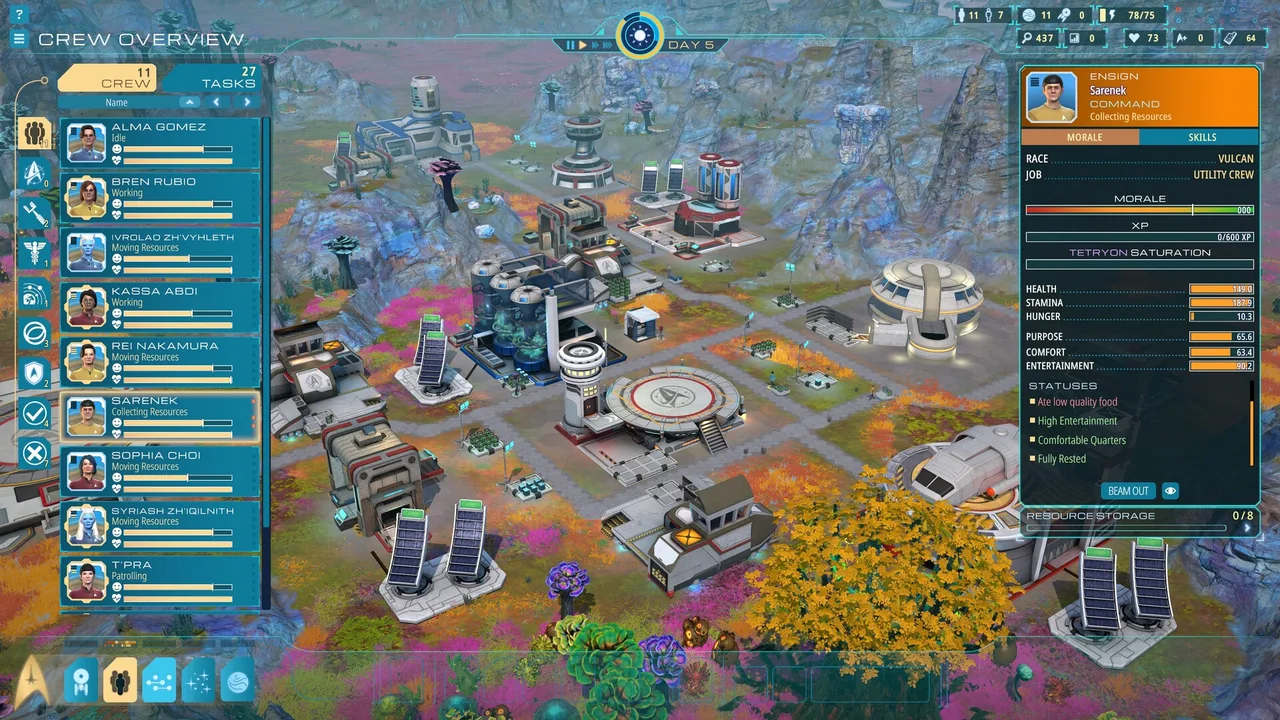
Official Steam screenshot · Magic Fuel Games / Playstack · TM & © 2026 CBS Studios Inc. Material statement.
Follow a resource through the full chain
The resource developer log describes multiple stages between finding material and using it in the outpost. That means a visible shortage should be read in the context of the work expected to supply the affected activity. Gathering additional raw material is not automatically the same thing as completing the processing or transport that another stage needs.
The useful first question is where the chain stops. This is a diagnostic interpretation of the announced sequence rather than a promise that every resource uses an identical recipe. The collected material does not establish a complete final catalog of conversions, so the exact requirement must come from the relevant information in the game.
Named resources are examples, not a complete database
The official resource log names Polyalloy, Duranium, Dutronic Chips, and Memory Banks among its examples. These names demonstrate the range of the documented system without supplying every item the game contains. They should not be presented as an exhaustive list simply because they are the examples directly mentioned in the source.
The dated count also needs care. The September log uses “over 55,” while the newer October material uses “55” when discussing unique resources. Preserve the dates and scope of those statements rather than combining them into a new total or inventing additional names to fill out a catalog.
Local gathering and refining in the demo
The GameGrin preview corroborates collection and refining as recurring concerns during its session. Retro-Badger's transcript around 10:37–10:52 independently documents early metal collection. Those observations support the role of material handling in the opening, while remaining evidence about a particular demonstration.
They do not establish that every resource can be obtained through the same interaction. Nor do they supply a final farming route or a universal worker allocation. Use the recorded activity as an example of one part of the chain, then check the actual resource and build before applying the same instructions more broadly.
Interplanetary transfers address local shortages
The interplanetary logistics log describes moving resources between planets to fill local supply shortfalls. This gives the resource question a wider context than a single collection point beside a single facility. The documented system allows support across outposts rather than treating every local shortage as an isolated gathering problem.
That description does not establish an unlimited supply or an exact transport schedule. It identifies a route through which a shortfall can be addressed. A practical guide should keep that relationship distinct from unverified capacity, timing, or efficiency claims that the collected material does not measure.
Periodic resupply is another documented route
The same official logistics material describes periodic external resupply. This is separate from local extraction and from transfers between the player's outposts. Understanding that distinction helps identify which kind of supply a particular piece of advice is actually discussing.
No final schedule or guaranteed resource quantity was verified in this research. A streamer's experience in one demonstration cannot establish every later delivery interval or choice. Treat the existence of the route as confirmed, while keeping its exact current terms attached to the information supplied by the version you are playing.
Utility requirements are part of resource planning
The resource log also links operating facilities with utility upkeep. A production problem may therefore involve the support a building needs, rather than only the raw material it is intended to process. This is why an input checklist should distinguish material supply from the other documented requirements of the activity.
The useful implication is to inspect the dependency that is actually missing. Increasing extraction will not automatically answer a connection or operating-support question. The power and building guides explain those adjacent systems so this page can remain focused on how the resource chain is supplied and interrupted.
Biological harvesting includes a regrowth context
The developer discusses seeds and regrowth alongside biological harvesting. That establishes an ecological relationship in the announced system, rather than describing every harvested specimen as a permanently exhausted one-way input. The source should be read at that level instead of being expanded into a numerical farming table.
No crop-cycle duration, output rate, or optimal planting arrangement was established in the collected material. Those values would require separate verification against the relevant build. A resource guide can explain the documented harvesting and regrowth relationship without promising a measured yield that the source does not provide.
Can a resource list explain a shortage on its own?
A list identifies items, but it does not necessarily identify where the supply chain has stopped. The documented loop includes several stages between discovery and use. That is why the useful troubleshooting question is about the missing stage rather than simply whether an item name appears in a catalog.
The same distinction applies to external resupply and interplanetary transfers. Their existence establishes additional routes, not a guarantee that every local problem is automatically resolved. A player still needs to identify the particular dependency associated with the waiting activity in the current game.
Use the named resource examples and dated counts as orientation rather than a substitute for those relationships. The collected material does not supply every recipe or rate needed for a complete production model. It does provide enough structure to distinguish an input, processing, transport, or utility question and choose the corresponding system guide.
Diagnose the bottleneck before scaling up
Identify the resource the waiting task requires, then establish whether the relevant stage is discovery, collection, processing, transport, or use. Check staffing and utility support where they affect that activity. These questions follow the documented relationships and help avoid treating every shortage as a reason to expand the same part of the settlement.
The research supports this chain-based overview, not a complete recipe database or a tested optimal farming loop. Use the current in-game catalog for exact quantities and conversions, and retain the build date when consulting a demonstration. The most useful next step is to locate the blocked stage rather than assume that more capacity everywhere is the answer.
Sources and update context
This page uses the official information collected for the October 18, 2026 research pass. Pre-release descriptions may change. Refer to the current storefront and developer announcements for availability and launch details.
- Captain’s Devlog #3 — Resources, Logistics, and Star Trek 60th
- Captain’s Devlog #2 — New Planet Gameplay Reveal: Kourou
- GameGrin — Star Trek: Outposts Unknown Preview
- But Why Tho? — Star Trek: Outposts Unknown Is A Star Trek Colony-Sim In Every Way
- RonEmpire — Full Gameplay, Steam Next Fest demo
- Retro-Badger-Gaming — Demo Playthrough with Commentary