
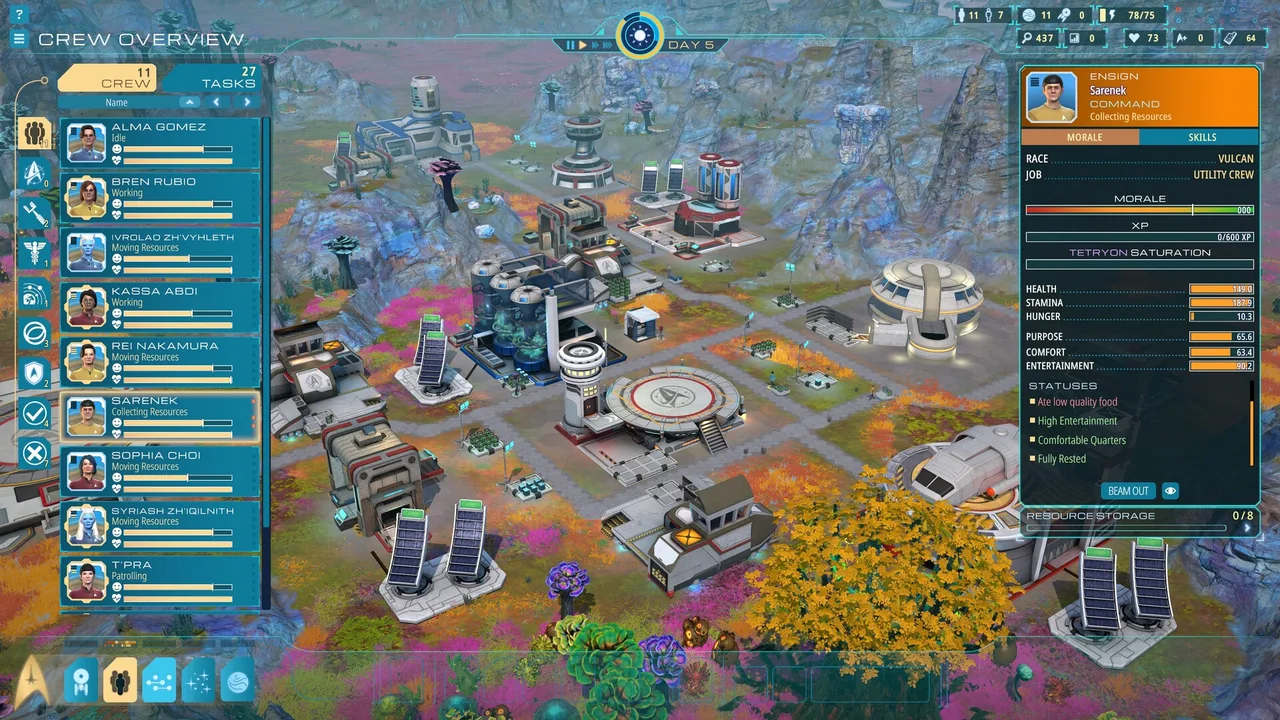
Official Steam screenshot · Magic Fuel Games / Playstack · TM & © 2026 CBS Studios Inc. Material statement.
What is confirmed about fusion fuel
The interplanetary logistics developer log explicitly names deuterium as an input for fusion generation. That is the direct source for the fuel relationship described on this page. It should not be replaced with an assumed fuel type merely because another Star Trek product uses familiar terminology differently.
The statement establishes a dependency, not a complete performance table. It does not provide a verified consumption rate, output number, or ideal ratio of generators to facilities in the collected material. A useful guide can identify the required input while leaving those unmeasured values attached to the actual game information rather than inventing them.
Power is part of building upkeep
The official resource and logistics description connects buildings with utility requirements, including power. This makes the supply question relevant to a facility's ability to operate rather than only to the act of placing it. A structure's presence on the map does not, by itself, establish that its operating dependencies are satisfied.
That distinction is important when diagnosing a warning. The visible building is where the problem appears, but the missing support may belong to another part of the documented system. Begin with what the game reports about that dependency rather than assuming every warning requires another copy of the affected structure.
Fuel and connections answer different questions
The developer's fuel statement and utility-network description point to distinct parts of the power problem. One concerns what supports generation, while the other concerns how utilities reach the places that need them. Keeping those questions separate is a useful diagnostic interpretation of the announced systems.
It is not a guarantee that every outage can be solved through the same sequence. The material does not provide a complete release-version list of all power failure conditions. Use the categories to organize the check, then follow the actual warning and requirements shown by the version you are playing.
What the independent demos corroborate
RonEmpire's transcript around 01:15:50–01:20:27 discusses a demo power problem and connection work. Retro-Badger's transcript around 39:25–39:49 independently encounters insufficient power. Their agreement supports the existence of a power-management concern in the demonstrated build rather than leaving the entire discussion dependent on promotional wording.
The recordings do not independently validate a final fuel-consumption rate. They also contain spoken observations that should not be converted into exact building labels when the automatic captions or commentary are uncertain. Their useful contribution is the versioned power problem, not a universal numerical solution or a complete generator catalog.
Infrastructure takes space in the outpost
The official logistics description says utility networks occupy physical space. That makes distribution part of the layout question as well as the supply question. A plan for facilities should therefore be considered together with how their documented utility requirements will be supported.
This principle does not establish an exact connection radius or required gap between buildings. No verified universal spacing formula was collected for this page. If a layout diagram is used to explain the relationship, it must remain an illustration of the dependency rather than a supposedly tested ideal grid.
Use the power warning as a starting point
Identify the affected activity before deciding what to add or change. Then distinguish the documented questions of generation input, utility connection, and the operating needs of the relevant facility. This approach keeps the investigation focused instead of treating every power issue as proof that a particular generator count is required.
The checklist is an editorial diagnostic grounded in the sources, not a developer-prescribed repair procedure. The collected material supports considering these dependencies but does not establish the final answer for every possible state. A current in-game requirement or explicit message is more useful than an old commentator's tentative guess about why a demonstration stopped working.
Why no output or capacity table is supplied
No verified wattage, battery capacity, cable radius, or generator-to-building ratio was found in the collected research. Adding one would create a precise-looking answer without the evidence needed to support it. The same applies to an unlimited-power exploit or a promise that a particular arrangement prevents every future shortage.
A numerical comparison would need the relevant final-build values and consistent operating conditions. That work was not established by either of the two demo sessions or the official overview. Until it is documented, this page keeps the confirmed dependency relationships separate from measurements that have not been verified.
Does a warning identify the cause by itself?
A power warning identifies a problem to investigate, but the collected material does not make every warning proof of one identical missing component. The official sources describe both a fuel relationship and utility support, while the demonstrations show problems being encountered in play. Those pieces support a structured check rather than a single promised repair.
Keep the observation separate from a commentator's proposed explanation. A tentative spoken building name or assumption is not enough to establish the current system's exact behavior. The recorded passage is most useful when it corroborates the problem category and directs attention back to the actual requirements.
For the player, that means checking the relevant dependency before copying an unverified numerical fix. Read the warning alongside the current generation, connection, and demand information the game provides. The guide can explain why those categories matter without claiming that a particular generator count or placement pattern resolves every possible power state.
Connect power planning with the other guides
Use the resource guide if the immediate question is how an input reaches the part of the outpost that needs it. Use the layout and building pages if the difficulty concerns space, placement, or the facilities involved. Those relationships help explain the documented system without turning the power page into an unsupported catalog of every structure.
The reliable starting answer is the developer's deuterium statement, supported by the broader official utility description and separate demo evidence for power problems. Check the actual warning, identify the missing dependency, and avoid assuming that an unverified numerical template applies to your build. That provides a useful direction while preserving the limits of what the collected sources establish.
Sources and update context
This page uses the official information collected for the October 18, 2026 research pass. Pre-release descriptions may change. Refer to the current storefront and developer announcements for availability and launch details.
- Captain’s Devlog #2 — New Planet Gameplay Reveal: Kourou
- Captain’s Devlog #3 — Resources, Logistics, and Star Trek 60th
- But Why Tho? — Star Trek: Outposts Unknown Is A Star Trek Colony-Sim In Every Way
- GameGrin — Star Trek: Outposts Unknown Preview
- RonEmpire — Full Gameplay, Steam Next Fest demo
- Retro-Badger-Gaming — Demo Playthrough with Commentary