
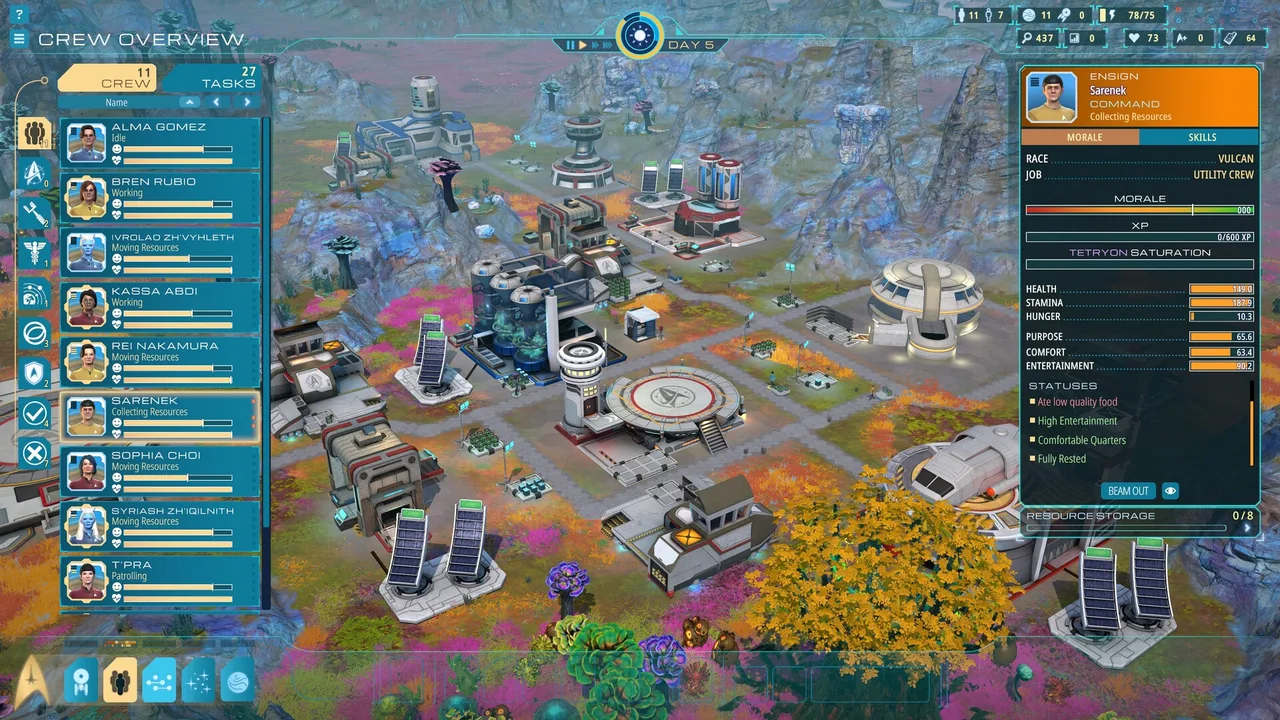
Official Steam screenshot · Magic Fuel Games / Playstack · TM & © 2026 CBS Studios Inc. Material statement.
What was actually reviewed?
The TrekNews article is explicitly based on the demo, and GameGrin labels its piece as a preview. Their publication context matters because the developer subsequently announced changes to systems discussed around the early build. Neither piece should be relabeled as a complete review of the final game merely because its headline remains visible near launch.
This distinction does not make the impressions worthless. It tells you what experience each writer can speak about and which conclusions need another check. A reader choosing whether to follow the game can learn from those sessions without pretending they cover every later system, mission, or release-version improvement.
TrekNews: a more relaxed reading of the demo
TrekNews presents the demonstration as an enjoyable, relaxed experience and highlights the appeal of managing the settlement. It also criticizes aspects of presentation and the effort required to navigate tutorial information. Those observations are the reviewer's impressions of the tested material rather than universal statements about every player's experience.
The combination is more useful than reducing the article to an entirely positive or entirely negative label. A player who enjoys this kind of pacing may respond differently from one who wants a more hands-off simulation. Read the praise and criticism together, while remembering that the article discusses a limited demonstration.
GameGrin: the demands of manual reassignment
GameGrin's preview is more critical of the time spent reallocating staff among tasks. Its account describes a management rhythm that did not align with the writer's preferred approach to setting systems up and letting them run. That is a relevant preference-based criticism, not an objective proof that the same interaction will disappoint everyone.
The preview also provides context for why staffing belongs in any evaluation of the game. A construction or production decision can be experienced as a management choice rather than a purely visual building action. For readers, the question is whether that kind of active attention is appealing, not whether two different reviewers must reach the same emotional verdict.
Why the two perspectives can differ
A relaxed overall pace and frequent reassignment are not mutually exclusive observations. One describes how a session feels, while the other describes the attention certain systems demand from the player. The two articles can therefore illuminate different aspects of the same limited build without creating a factual contradiction that needs an invented average.
This is why the review context should retain attribution. Saying that a particular writer enjoyed the pace is different from declaring the game universally relaxing. Likewise, saying another writer disliked the repeated staff changes is different from treating that preference as a definitive final-release failure.
Changes announced after the first demo
The official post-demo developer log documents adjustments announced after early feedback. A later pre-launch log records further work before the planned release. That timeline makes it important to avoid assuming every concern raised during an early demonstration describes the later build unchanged.
At the same time, an announced adjustment is not proof that a particular complaint has been fully resolved in actual play. The research does not contain a completed final-build retest of every issue raised by the reviewers. The fair reading is that the tested version and the later announcement belong together as context, rather than one automatically cancelling the other out.
What gameplay commentary adds
Two early-demo videos provide separate player perspectives in addition to the written press coverage. Their English automatic transcripts were retrieved, so selected comments can be understood in the context of the recorded sessions. They remain commentary from those particular demos rather than a substitute for a scored assessment of the finished campaign.
The value of these recordings is that a reader can examine how a session unfolds instead of relying only on a short verdict. The limitation is that recording date, player choices, and the demonstrated build all affect what is being observed. Do not treat a commentator's experience as evidence that every later player will encounter the same pacing or system behavior.
What the research cannot score
No final Metacritic or OpenCritic consensus was established in the material collected for this page. Nor did the research establish a completed final-campaign evaluation from which this wiki could honestly derive its own numeric rating. A score would therefore add apparent precision without the testing or review population needed to support it.
The same limit applies to a blanket purchase recommendation framed as a final verdict. The available evidence can explain which management ideas appealed to reviewers and which parts they found less satisfying. It cannot settle the quality of content those sessions did not cover or verify that every announced improvement works as intended.
Which kind of evidence should guide your expectations?
Firsthand impressions are strongest when they describe the session the reviewer actually played. The two written pieces used here do that from different preferences and with different reactions to the pace and assignment work. Keeping those perspectives separate is more informative than converting them into an unsupported single score.
Official update notes answer another question: what the developer announced after feedback. They provide valuable context for older observations but do not independently retest the reviewer's concern. A fair expectation should distinguish that announced work from a verified assessment of how the later build feels in practice.
The recorded demo commentary adds another experience to examine, not a substitute for all of the missing release coverage. It can help you decide whether the demonstrated management rhythm interests you. The final campaign and the interaction of later changes still require a review of the actual released build before they can support a final verdict.
How to use these impressions
Compare the reviewers' preferences with your own interest in paced settlement management and active task assignment. Keep the version label beside each impression when considering whether an early concern still matters to you. The guide and crew-management pages explain the documented systems without turning a preview opinion into an unsupported mechanic or score.
For now, the strongest answer is a comparison of attributed demo impressions with the later official update timeline. That gives you a clearer picture than presenting a fabricated consensus or promoting an old preview to a final review. A full-release verdict needs a known released build and sufficient play coverage, which this particular research does not establish.
Sources and update context
This page uses the official information collected for the October 18, 2026 research pass. Pre-release descriptions may change. Refer to the current storefront and developer announcements for availability and launch details.