
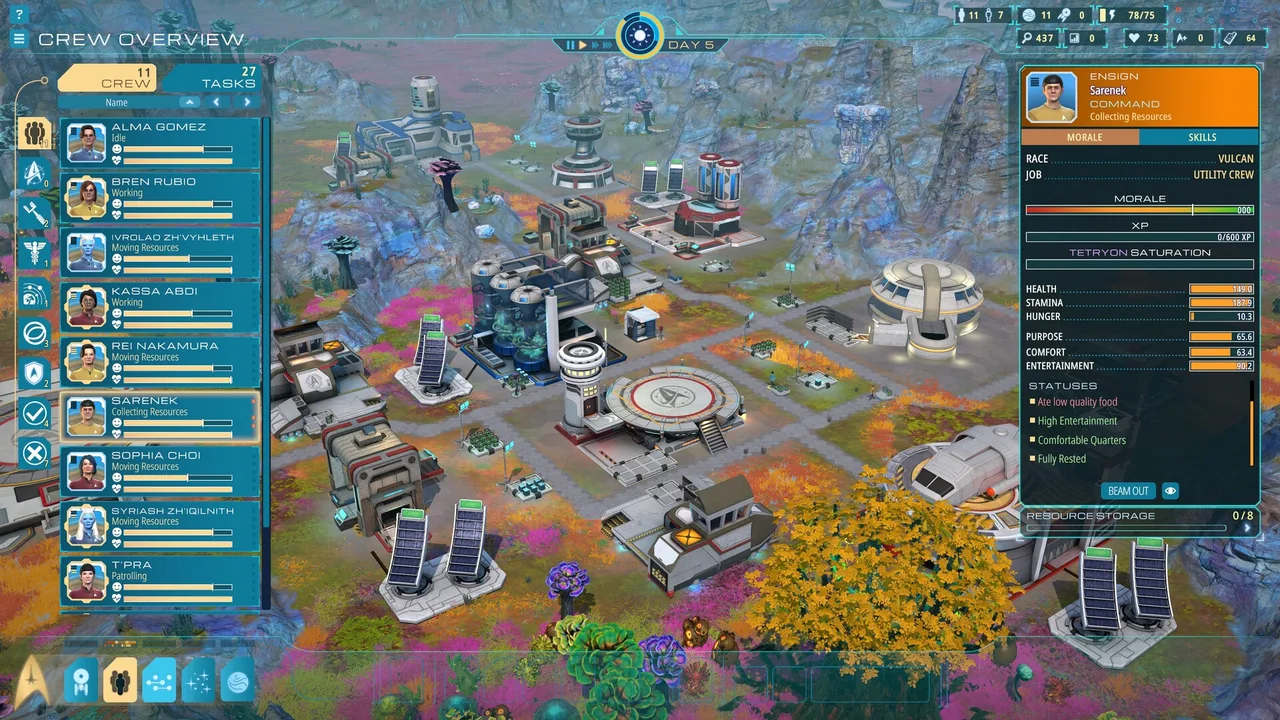
Official Steam screenshot · Magic Fuel Games / Playstack · TM & © 2026 CBS Studios Inc. Material statement.
Your first decisions concern the expedition
The researched demo footage begins with crew selection before the surface phase. RonEmpire's transcript places that selection around 08:20, followed by the move toward the starting planet. This establishes the broad opening structure, rather than proving that one available team is the best possible choice for every player.
Think of the initial selection as the starting point of your management responsibilities. The official demo material introduces crew duties as part of the expedition, and the later systems rely on assigning people to work. The recordings support that connection without supplying a final-build ranking of starting personnel or a universal selection rule.
Explore before treating the map as a building plan
The two inspected recordings both show an exploration stage before a functioning Operations Center. Retro-Badger's transcript places the early exploration activity around 06:30–15:21. This is useful evidence for how the demo introduces the setting, but not a basis for assigning the same timestamps to another player's run.
Exploration matters in the beginner overview because it precedes several decisions about gathering and establishing the outpost. The later construction tasks do not exist in isolation from what the expedition discovers. Follow the actual objective in the version you are playing, rather than copying every movement made in an older demonstration.
Construction needs materials and people
The researched hands-on coverage describes staff being reassigned between production and construction. That means a building decision is also a question about what your available crew is doing. A beginner should understand this relationship before assuming that selecting another structure automatically resolves a shortage elsewhere in the settlement.
The practical starting point is to identify the dependency that is missing. Materials, an assigned worker, and access to the intended structure are separate concerns in the documented systems. This is a way of reading the management loop, not an untested claim that a particular staffing ratio will maximize progress.
Resource work supports the rest of the outpost
The collected material connects gathering with production and construction rather than presenting resources as a separate activity. Materials are part of what lets an expedition establish and operate its facilities. When you read a guide about a particular resource, keep the reason you need it connected to the work it will support.
This perspective helps distinguish a supply problem from a staffing problem. More collection is not automatically the answer if the relevant task is waiting on another dependency. The research supports learning those links, but it does not establish a complete final recipe table or an optimal production order to copy without checking the game.
Research belongs to the same progression loop
Research and facility progression are part of the announced experience, and the early demos connect them with the developing outpost. The beginner page introduces that relationship rather than attempting to duplicate an entire technology guide. Use the research page when your question concerns data acquisition or access to a laboratory in the recorded demo.
A useful habit is to distinguish a system's existence from a fully documented path through it. The collected sources support discussing research as a core activity without proving every later requirement. An introductory route should therefore explain what to look for, while avoiding invented costs, node orders, or promises that every unlock works identically in the final build.
Crew assignments affect several systems at once
Staffing is a recurring theme in the firsthand preview because the same outpost needs different kinds of work completed. A person reassigned to one task is no longer being used in precisely the same way elsewhere. That relationship makes the crew screen relevant to building and production questions, rather than a disconnected character-management menu.
Use that connection to frame a problem before deciding what to change. Ask which activity is waiting, which work is staffed, and which other system is meant to support it. These are diagnostic questions grounded in the described management loop, not an assertion that a specific crew arrangement has been tested as the fastest opening.
Early demo routines changed after feedback
The official post-demo developer log announced staffing and local-support changes after the first demonstration. That means early routines shown by reviewers and streamers need their original build context. A beginner guide should not silently convert every observed behavior into a statement about the later release.
The right approach is to learn the broad relationships while checking the current instructions for the details. A video can clearly establish how a particular demonstration unfolded and still be outdated about a later system adjustment. Keep the difference visible when following a route, especially where a guide relies on staffing schedules or the way the outpost is supported.
How do you keep the opening manageable?
Choose the focused question that explains the current objective instead of treating every guide as one continuous checklist. The opening material introduces several connected systems, so a short pause to identify the relevant dependency can be more useful than copying another player's entire session. This is an editorial way of navigating the documented information, not a promised optimization of the game.
For example, the distinction between construction access and staffed work already appears in the researched management context. Understanding which question you are asking prevents a resource guide from being used as the answer to an unlock problem. The same principle keeps a beginner overview from duplicating the more specific research and crew pages.
Continue to follow the current game's own objectives where a historical demonstration differs. The researched sources explain broad relationships and the observed opening, while later changes supply important version context. Use both for their proper purpose instead of assuming that a video timestamp or one commentator's choice is a rule every new player must follow.
Follow the question that is actually blocking you
A beginner overview is most useful when it helps you identify which system needs a closer look. If your question is about placing a structure, go to building; if it concerns inputs or transport, go to resources. If work is not happening as expected, the crew and research guides may be more relevant than another general introduction.
That division keeps the opening guidance readable without pretending to replace a complete mission walkthrough. The sources establish the expedition's broad early structure and several connected management systems, not a proven perfect start. Use this guide as a map of those relationships, then follow the specific objective and information supplied by your actual game version.
Sources and update context
This page uses the official information collected for the October 18, 2026 research pass. Pre-release descriptions may change. Refer to the current storefront and developer announcements for availability and launch details.